TL;DR
MCP is an open standard (Anthropic 2024) that lets any AI system discover and securely use tools, data and prompts—without bespoke connectors for every integration.
1) What Is MCP?
MCP is a universal protocol that connects large-language-model (LLM)–powered apps to external tools, data and services through a single, consistent interface.
It eliminates brittle "point-to-point" integrations by standardising discovery, context sharing and permissioning across the entire stack.
2) Why MCP Beats Traditional REST APIs
| Challenge with REST | How MCP Solves It |
|---|
| 1 · Dynamic context – REST is stateless; LLM agents need memory across multi-step workflows. | Built-in session & conversation context lets agents "think" over extended tasks. |
| 2 · N × M integrations – Every new tool ↔ every new AI means exponential connectors. | "Build once, connect many" architecture dramatically cuts integration work. |
| 3 · Intent & usage metadata – APIs tell what you can call, not when / why. | MCP bundles prompts & examples so agents know how to use each tool. |
| 4 · Enterprise-grade security – REST lacks fine-grained, human-readable scopes. | Consent flows & granular scopes are baked into the spec. |
3) Core Components
| Component | Role |
|---|
| Host | Front-end AI interface (chatbot, IDE, mobile app). |
| Client | Maintains the socket / Web-RPC connection to an MCP server. |
| Server | Publishes tool catalogue, resources and prompts. |
| Tools | Discrete actions the AI can invoke (e.g., "create-ticket", "send-email"). |
| Resources | Data sources such as CRMs, wikis, or databases. |
| Prompts | Instruction templates guiding the AI's behaviour with each tool or dataset. |
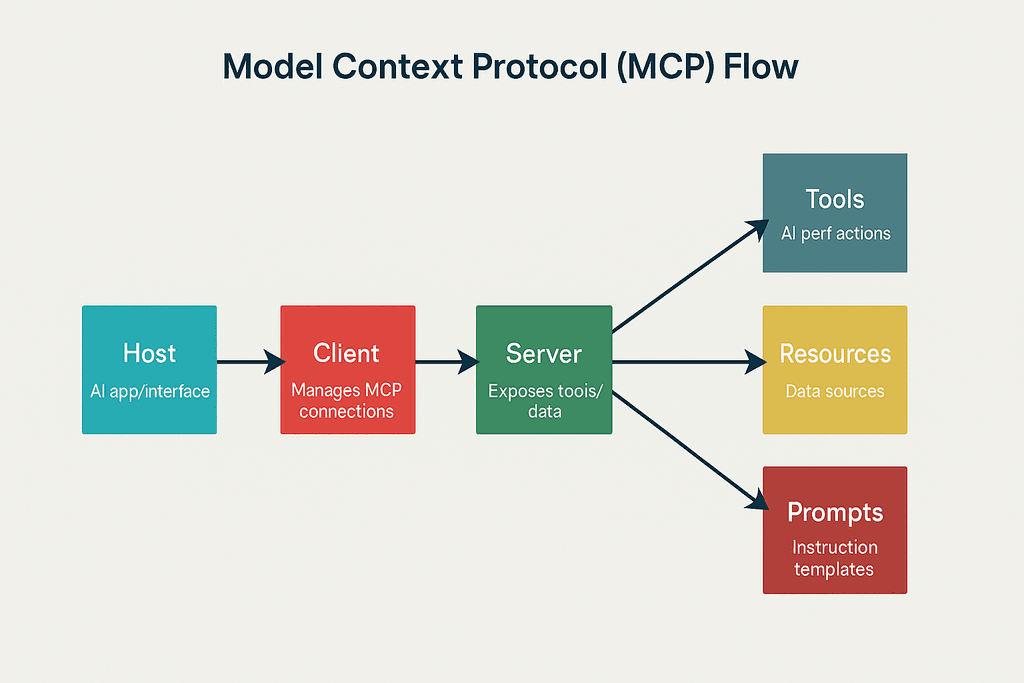
Figure 1 — High-level data-flow: the Host talks to a Client which in turn connects to an MCP Server exposing Tools, Resources and Prompts.
4) Business Use-Cases
- Enterprise process automation – Agents plan, coordinate and execute across CRM, PM and wiki systems with zero extra plumbing.
- Real-time personalised support – Context hand-off lets an AI fetch relevant customer history mid-conversation.
- Compliance-driven data access – Fine-grained scopes mean finance/healthcare organizations expose only what's needed.
- Cross-platform continuity – Session state follows users between desktop, web and mobile.
- Developer acceleration – One connector plugs LLMs into IDEs, bug-trackers and code-review pipelines.
5) The Road Ahead
- Enterprise adoption is snowballing as vendors ship MCP-native plugins.
- Near-term roadmap: federated learning, offline consent and quantum-safe handshakes.
- Vision: an open, interoperable fabric where autonomous agents safely act across the entire digital estate
6) Takeaway
MCP is poised to become the backbone for context-aware, tool-using AI.
Teams that adopt it early can cut integration cost, tighten security and unlock sophisticated autonomous workflows.